





8.0

Expert Trainers

Proven Strategies

High Success Rate
 Proud Moment!
8.0

8.5

8.0

7.0

7.5
you can be next!

Trusted by 1000+ Students

Picture this. You’ve drilled listening for weeks. Reading feels manageable. You walk into the Pune test center ready — then the examiner slides a small card across the table, starts a one-minute timer, and your mind goes blank.
That one card carries a serious share of your speaking band. Which is exactly why hunting for the latest IELTS cue cards is one of the smartest moves you can make before test day.
But here’s what most websites won’t tell you: memorising cue card answers pulls your score down. What lifts it is an idea bank, a repeatable structure, and honest feedback from someone who knows the band descriptors. This guide gives you all three.
Quick answer: The latest IELTS cue cards for 2026 follow a four-month rotation — January–April, May–August, and September–December. Roughly half the topics carry over from the previous cycle. Common 2026 themes include influential people, delayed journeys, useful apps, noisy places, and mistakes you learned from.
The latest IELTS cue cards for 2026 are the Part 2 topics currently circulating in the four-month test cycle. IELTS does not release them officially — teachers compile them from candidate reports. As IELTS specialist Elizabeth Ferguson (IELTS Liz) confirms, speaking topics are refreshed every four months, but they stay recycled, common topics rather than genuinely new ones.
That recycling is your advantage. Cathoven’s 2026 cue card bank logged 55 topics in the January–April season: 27 new and 28 retained from the previous cycle — so roughly half of what you prepare stays valid into the next window.
Here are the themes dominating the 2026 rotation, grouped the way we teach them:
Notice the pattern? Nine out of ten cue cards ask you to tell a story about yourself. Prepare six strong personal stories, and you can stretch them across forty prompts.
A Band 9 cue card answer uses a four-part structure: a one-line setup, a specific story with concrete detail, a moment of reflection, and a clean close. It fills the full two minutes, covers every bullet on the card, and sounds spoken — not recited. Take “Describe an important journey that was delayed”:
“I’d like to talk about a trip to Delhi last December for my sister’s engagement. My flight from Pune was at 6 a.m., and I reached the airport painfully early — around four — only to find the board flashing ‘delayed’ with no revised time. Fog in Delhi, apparently.
What made it stressful wasn’t the wait — it was the uncertainty. Every hour they’d push departure back another ninety minutes, and I sat there close to seven hours getting the same vague answers.
Looking back, it taught me something about buffer time — I now fly a day early for anything that matters. And I got talking to another stranded passenger from my hometown, so the delay gave me a friend I still speak to.”
Notice what’s doing the work: a real date, a real city, a specific number, an emotional shift, a reflective ending. No fancy vocabulary. The score comes from natural detail.
Here’s how the same topic sounds at two different bands:
| Assessment Area | Band 6 Response | Band 9 Response |
|---|---|---|
| Fluency | Stops at 55 seconds, long pauses | Fills 2 minutes, self-corrects smoothly |
| Detail | “I went to Delhi, and the flight was late.” | “6 a.m. flight, fog in Delhi, seven-hour wait” |
| Vocabulary | very bad, very late, a lot of problem | painfully early, vague answers, buffer time |
| Grammar | Present tense throughout a past story | Past simple, past continuous and present perfect mixed naturally |
| Ending | Trails off, waits for examiner | Rounds off with a reflection |
Most Pune candidates lose Speaking marks not because their English is weak, but because they translate mentally from Marathi or Hindi, memorise scripted answers, and stop speaking too early. Indian test-takers average around Band 6.1 in Speaking (IELTSMaterial, 2025 test-taker data) — and the gap to Band 7 is almost always structural, not linguistic.
Take Rohan, a software engineer from Hinjewadi, who came to us after his second attempt: overall 7, Speaking 6.5, needing 7 across the board for Canada PR. His English was fine — he ran client calls with Boston daily. But he’d memorised eleven cue card answers off YouTube, and when asked about a noisy place, he forced his rehearsed “crowded market” answer into it. The delivery went flat. Examiners are trained to spot exactly this. IELTS guidance is blunt on this: memorized answers are penalized, and every response must be spoken naturally on test day.
The recurring mistakes we correct in our Pune classrooms:
Rohan spent five weeks in one-on-one practice, recording every answer against the descriptors. Next attempt: 7.5.
Most students move from Band 6 to Band 7 in speaking within 6–8 weeks of structured practice, provided they get recorded feedback at least twice a week. Speaking improves faster than writing because the fixes are behavioral — timing, structure, and detail — not purely linguistic.
Here’s the four-week roadmap we run at IELTS With Madhav:
| Week | Focus | What You Actually Do |
|---|---|---|
| Week 1 | Idea bank | Draft 6 flexible stories: a person, a place, a trip, an object, a mistake, a goal |
| Week 2 | Structure & timing | Record 2 cue cards daily; hit 1:50–2:00 every time |
| Week 3 | Language upgrade | Replace weak vocabulary, widen past-tense range, fix intonation on playback |
| Week 4 | Pressure testing | Full mock speaking tests plus Part 3 follow-ups |
Priya, a staff nurse from Kothrud preparing for UK NMC registration, followed exactly this plan. Her problem was the opposite of Rohan’s — fluent delivery but clinical one-layer answers with no reflection. Four weeks later: Band 6 to 7.5.
Self-study vs. coaching: free topic lists and model answers get you started, but self-study can’t give you an honest read on your own fluency, the pronunciation blind spots you can’t hear, or Part 3 pressure. Coaching adds band-descriptor feedback on every recording, one-on-one practice, and real-condition mocks.
At IELTS With Madhav, we have become a trusted name for IELTS coaching in Pune because we treat speaking as a skill to be coached, not content to be memorized. Students from Kothrud, Deccan, FC Road, Wakad and Hinjewadi work through the latest IELTS cue cards in batches small enough that everyone speaks every session — with personalised study plans, unlimited mock tests and one-on-one practice built in.
Explore our IELTS Coaching in Pune and Spoken English Classes in Pune pages to see how the full course is structured.
You now know what the latest IELTS cue cards look like, how a Band 9 answer is built, and why memorising keeps students stuck at 6.5. What’s left is practice with someone who hears what you can’t.
At IELTS With Madhav, every student gets a personalized study plan, unlimited mock tests with feedback, and one-on-one speaking practice — online or at our Pune center.
📞 Book your free demo with Madhav today and find out exactly which band your cue card answers are sitting at right now.
Visit our Contact / Book Free Demo page to get started.
📍 Location: Pune, Maharashtra
📞 Call / WhatsApp: +91-8855829557
🌐 Website: ieltswithmadhav.com

The latest IELTS cue cards are compiled by coaching institutes from real test-taker reports, because IELTS itself never publishes them. Topics refresh every four months—January–April, May–August, September–December—with around half carried over. Practice across categories rather than chasing a "leaked" list—there isn't one.
Your cue card answer should run the full two minutes, ideally 1:50–2:00. You get one minute to prepare and up to two to speak. Stopping at 60 seconds signals limited fluency and typically caps that criterion around Band 6.
No—memorized answers are penalized by examiners, who spot rehearsed delivery through unnatural rhythm and flat intonation. Prepare ideas, vocabulary, and structure instead, then speak spontaneously on test day.
You can adapt any personal story to almost any cue card, and examiners do not assess truthfulness. Cue cards test your English, not your life experience—which is why we build six flexible stories that reshape to fit unfamiliar prompts.
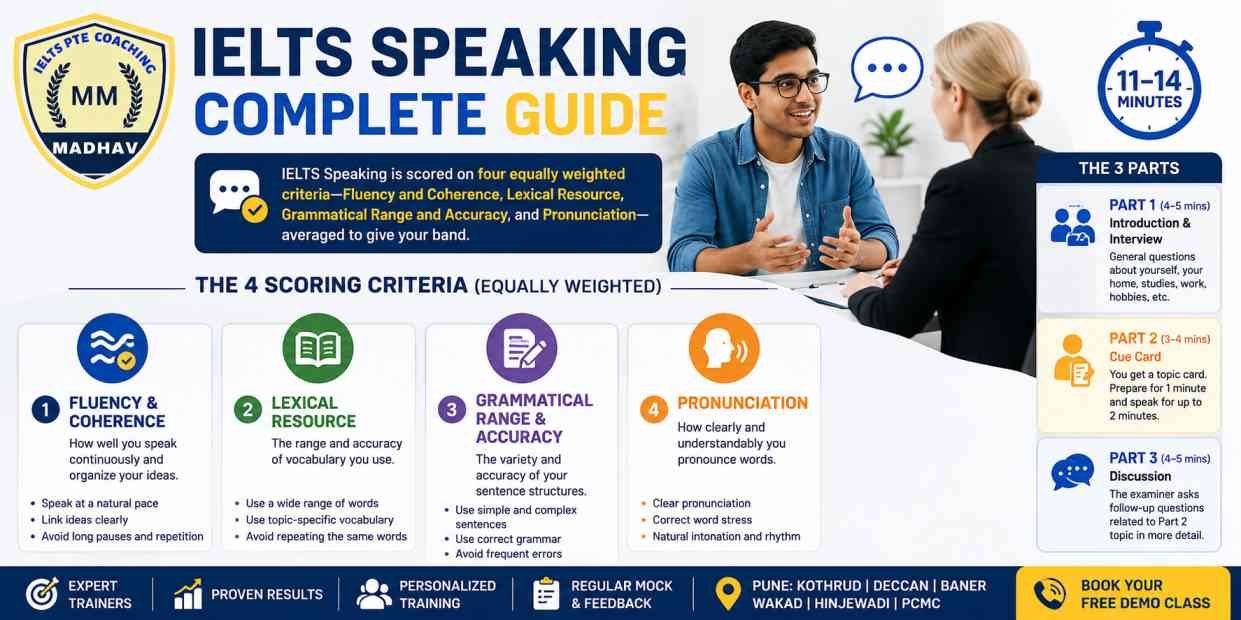
IELTS Speaking is scored on four equally weighted criteria—Fluency and Coherence, Lexical Resource, Grammatical Range and Accuracy, and Pronunciation—averaged to give your band. The test runs 11–14 minutes across three parts, with the cue card as Part 2.
Get expert guidance, personalized study plans, and real exam strategies
to crack IELTS, PTE, TOEFL & more with confidence
Top learning experiences that create more talent in the world.