





8.0

Expert Trainers

Proven Strategies

High Success Rate
 Proud Moment!

8.0

8.5

8.0

7.0

7.5
you can be next!

Trusted by 1000+ Students

If that score report looks familiar, you’re not alone. You’re probably searching for the best online IELTS classes in Andheri Mumbai right now. For a SEEPZ techie building a Canada PR profile, or a Versova graduate chasing a September UK intake, one weak Speaking band can push everything back by months.
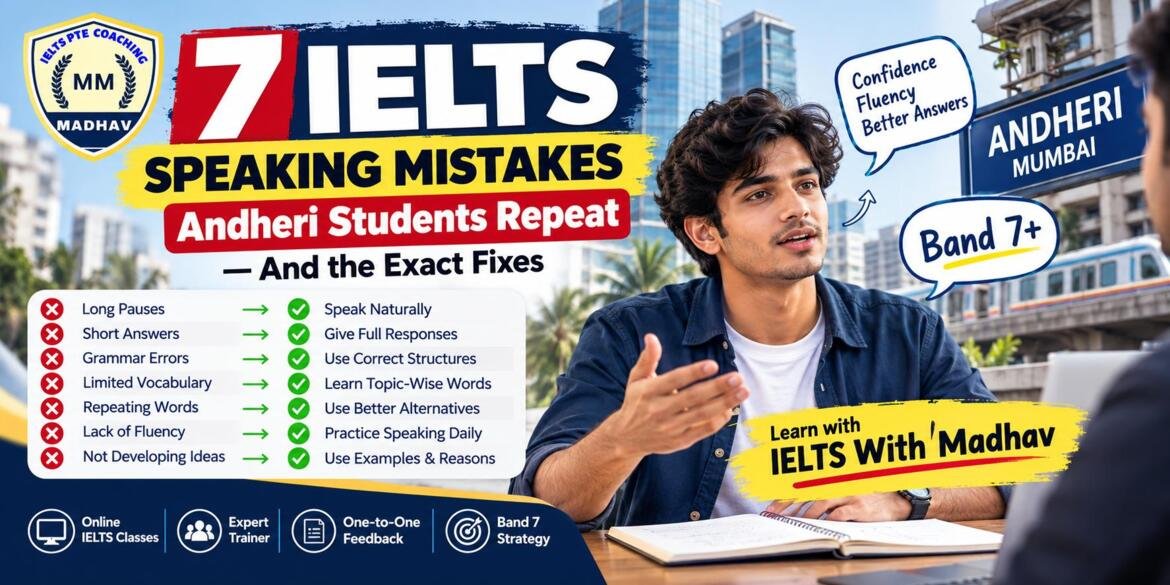
Here’s the honest truth from our classroom: Speaking bands rarely drop because of weak English. They drop because of a handful of repeatable habits. Below are the seven we correct most often in our live online batches, with the exact fix for each.
Quick Answer: The most common IELTS Speaking mistakes are memorised answers, translating from your mother tongue, misused “big” vocabulary, one-line Part 1 replies, stopping early in Part 2, personal stories in Part 3, and rushed, flat pronunciation. Fix them with timed recorded practice, examiner-style feedback and 6–8 weeks of structured coaching.
IELTS Speaking is an 11–14 minute face-to-face interview in three parts, scored equally on four criteria: Fluency and Coherence, Lexical Resource, Grammatical Range and Accuracy, and Pronunciation. Since September 2026, IELTS in India is computer-delivered, but Speaking is still conducted live with a certified examiner.
Many Andheri students assume Speaking went digital too. It hasn’t. You still sit across from a human who notices every hesitation, rehearsed line and flat sentence.
The upside? With equal weighting, fixing even one weak area can tip your average into the next half-band.
The seven mistakes we correct most often are memorised answers, mental translation, forced vocabulary, short Part 1 replies, stopping early in Part 2, storytelling in Part 3, and rushed or flat pronunciation. Each one maps to a scoring criterion, which means each one has a specific, trainable fix.
Examiners are trained to spot rehearsed language, and a scripted answer usually collapses at the first follow-up question. We once had a Lokhandwala student who had memorised 40 cue-card answers and froze at a simple “Why?”
The fix: Memorise ideas, not sentences. Build three flexible story banks (a person, a place, an experience) that you can bend to fit almost any topic.
This creates long mid-sentence pauses and literal phrases like “I am having two brothers.” It quietly drags down both Fluency and Grammar.
The fix: Think in short English chunks. Practise shadowing, repeating a 30-second clip of natural English aloud, for ten minutes a day.
Words like “plethora” sound impressive until they’re used wrongly. Lexical Resource rewards precise, natural word choice, not rare words.
The fix: Learn topic collocations such as “a hectic commute”, “a tight deadline” and “strike a work-life balance”, then use them in real answers.
“Do you like cooking?” “Yes, I like.” Full stop. A short answer gives the examiner nothing to assess.
The fix: Use the A-R-E method: Answer, give a Reason, add an Example. Aim for two or three sentences.
Many students stop at 60–70 seconds and stare at the examiner. The cue card asks you to speak for up to two minutes, and silence costs Fluency marks.
The fix: Use your one minute of preparation to jot one keyword per bullet. Then extend with how you felt and what you would do differently.
Part 3 asks abstract questions, like “Why do cities like Mumbai struggle with traffic?” A personal anecdote misses the point.
The fix: Switch to general reasoning. Give a view, explain causes, compare, and speculate about the future.
Many professionals think speed equals fluency. It doesn’t. Rushed, monotone speech, plus common v/w confusion, makes you harder to follow.
The fix: Record yourself, slow down slightly, and stress the key word in each sentence. Pronunciation is about clarity, not a British accent.
Most students move from Band 6 to Band 7 in Speaking within 6–8 weeks when they practise daily and get structured, criterion-by-criterion feedback. Students who only watch videos often stay stuck for months, because nobody corrects the habits that cost them marks.
Picture an IT professional from Andheri East stuck at Speaking 6.0 on his second attempt. He needs a 7.0 in Speaking, which is CLB 9, to strengthen his Express Entry score. His English is fine. His memorised Part 2 answers are not.
Here’s the roadmap we usually follow:
| Week | Focus | What you do |
|---|---|---|
| 1 | Diagnostic | Full recorded mock, criterion-wise band report |
| 2–3 | Fluency habits | Shadowing, A-R-E answers, story banks |
| 4–5 | Vocabulary & grammar | Topic collocations, complex sentences, error log |
| 6 | Pronunciation | Word stress, intonation, pacing drills |
| 7–8 | Exam simulation | Two to three timed one-on-one mocks per week |
Self-study works for Listening and Reading, but Speaking needs a live listener. You cannot reliably hear your own fillers, grammar slips or flat intonation. Structured online coaching adds timed mocks, examiner-style feedback and accountability, the three things self-study can’t give you.
| Factor | Self-study | Structured online coaching |
|---|---|---|
| Feedback on Speaking | None or guesswork | Criterion-wise, after every mock |
| Mock interviews | Rarely realistic | Live, timed, one-on-one |
| Accountability | Depends on willpower | Fixed batch schedule |
| Typical Band 6 → 7 time | Often months | 6–8 weeks |
For Andheri learners, online also kills the commute: no crawling down the Western Express Highway at 7 pm.
Yes. IELTS One Skill Retake lets you resit just Speaking within 60 days of a computer-delivered test, and since all IELTS in India is now on computer, every Andheri candidate can use it. However, IRCC does not accept One Skill Retake results for Canada Express Entry.
So if Canada PR is your goal, plan to clear Speaking in one complete sitting. For UK or Australian admissions, check your university’s One Skill Retake acceptance list first.
The best online IELTS classes in Andheri Mumbai offer live one-on-one Speaking mocks, criterion-wise feedback, small batches and flexible evening or weekend timings. IELTS With Madhav, a trusted name for IELTS coaching in Pune, runs live online batches for Mumbai learners with exactly this structure.
Madhav’s team brings the same personalised study plans and unlimited mock tests with feedback used in our Pune classrooms in Kothrud and Hinjewadi to students logging in from Andheri, Jogeshwari and Goregaon. Alongside IELTS, the team also coaches PTE, OET and Spoken English. Before booking your test date, confirm slots on the official IDP IELTS test centre locator.
Your English is probably better than your score suggests. Let’s prove it. Book your free demo with Madhav today and get a live Speaking diagnostic. When you’re ready to choose the best online IELTS classes in Andheri Mumbai, start with a team that knows exactly which habits are holding you back.
👉 Book your free demo with Madhav today.
📞 Call or WhatsApp : 8855829557
🌐 visit : www.ieltswithmadhav.com

Yes, live online classes are one of the most effective ways to prepare for IELTS Speaking from Andheri. One-on-one video mocks replicate the face-to-face interview, and you save the daily commute across Mumbai.
Yes, memorised answers usually score lower because examiners are trained to recognise rehearsed language. They also fall apart when a follow-up question changes direction, which hurts Fluency and Coherence.
No, an Indian accent does not lower your score by itself. Pronunciation is judged on how easily the examiner understands you and how well you use stress, rhythm and intonation.
Thirty to forty-five minutes of focused daily practice is enough for most working professionals. Combine recorded answers and shadowing with at least one feedback session per week.
No, IELTS Speaking is still a face-to-face interview with a certified examiner in India. Only Listening, Reading and Writing moved to computer when paper-based IELTS ended in August 2026.
Get expert guidance, personalized study plans, and real exam strategies
to crack IELTS, PTE, TOEFL & more with confidence
Top learning experiences that create more talent in the world.