





8.0

Expert Trainers

Proven Strategies

High Success Rate
 Proud Moment!
8.0

8.5

8.0

7.0

7.5
you can be next!

Trusted by 1000+ Students

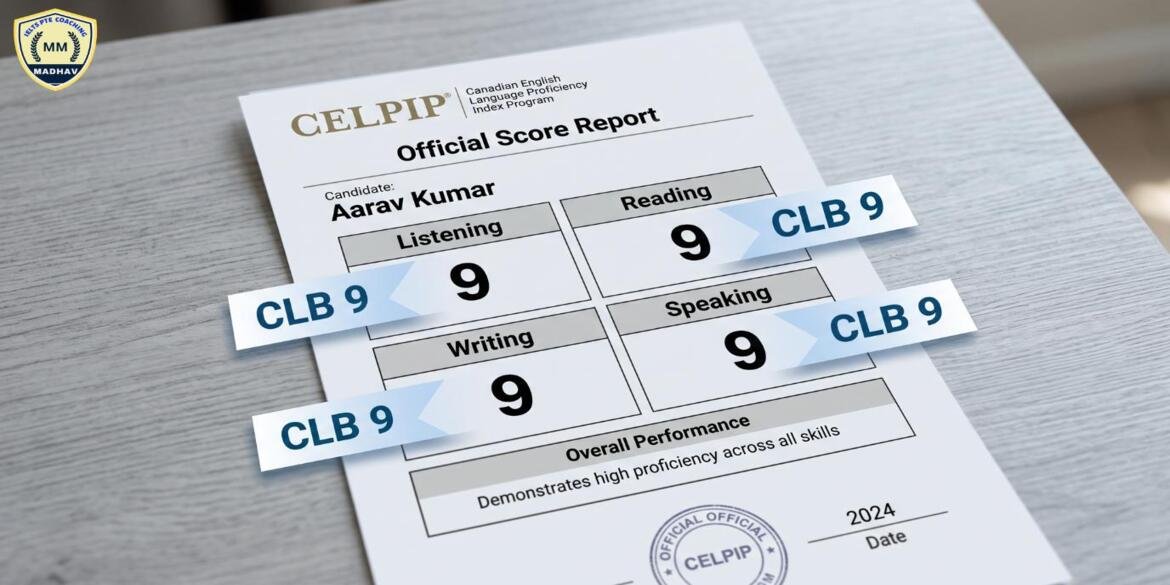
You have the degree. You have the experience. Your CRS sits at 462, and the last three Express Entry draws closed above 490. So what’s actually holding you back?
Almost always, it’s four numbers on a language report. Understanding how to score Level 9 in CELPIP is one of the fastest ways to improve a stuck Express Entry profile because language is one of the CRS factors you can change in weeks rather than years. Your age won’t improve. Your degree won’t upgrade itself. But a Level 8 Writing score can become a 9—and that single change can improve multiple parts of your profile.
To score Level 9 in CELPIP, you need to achieve CELPIP 9 in all four skills—Listening, Reading, Writing, and Speaking—because CELPIP scores map directly to CLB levels. Focus on task-specific strategies and response structures rather than trying to improve general English alone. Most working professionals who are already around Levels 7–8 can realistically reach Level 9 within 6–10 weeks when they receive targeted feedback, particularly on Writing and Speaking.
CELPIP Level 9 equals CLB 9 in each of the four skills, and achieving CLB 9 across all four abilities is an important threshold for maximising Express Entry skill-transferability benefits. IRCC’s official equivalency framework maps CELPIP Reading, Writing, Listening, and Speaking directly to CLB levels. In other words, a CELPIP score of 9 corresponds directly to CLB 9.
| Your CLB Level (All 4 Skills) | Approx. Core Language CRS Points (Single Applicant) | Skill-Transferability Bonus |
|---|---|---|
| CLB 7 | ~68 | Partial (25-point tier) |
| CLB 8 | ~92 | Partial (25-point tier) |
| CLB 9 | ~124 | Maximum tier unlocked |
| CLB 10+ | ~136 (ceiling) | Maximum tier |
IRCC’s criteria are explicit: the maximum skill-transferability bonus requires CLB 9 or higher in all four first-language abilities. Scoring CLB 10 in three skills while receiving CLB 8 in one skill does not unlock the same maximum tier. This is one of the most common mistakes candidates make when planning their Express Entry language strategy.
Score Level 9 in CELPIP Listening and Reading by mastering pacing and question types rather than simply memorising more vocabulary. Listening runs for approximately 46–55 minutes across six parts, while Reading takes around 43–56 minutes across four parts. The audio plays only once and you cannot go back, so disciplined note-taking can make a major difference to your score.
Most candidates lose Listening points in Parts 5 and 6, where speakers may disagree and you need to keep track of exactly who said what. In Reading, Part 2 (Applying a Diagram) is a common score killer because the skimming habits developed for IELTS Academic do not always transfer effectively to CELPIP.
Here are the practical habits that can help lift Listening and Reading scores toward Level 9:
To score Level 9 in CELPIP Writing and Speaking, focus first on register and content depth. Writing gives you approximately 53 minutes for two tasks—an email and a survey response—while Speaking is a roughly 15-minute, eight-task section delivered directly to a microphone. These two sections are responsible for many Level 8 plateaus.
We see this issue in almost every Pune batch. A Marathi- or Hindi-medium educated professional may begin CELPIP Writing Task 1 with a sentence such as “Respected Sir, I am writing to bring into your kind notice…”
The sentence is grammatically understandable, but it can still limit your score. CELPIP raters evaluate whether your tone and language match the situation. Many Task 1 prompts involve everyday communication with a neighbour, landlord, manager, or another person you already know. Excessive formality can therefore sound unnatural rather than polite. A more natural Level 9 opening might be: “Hi Neha, I wanted to follow up about the parking issue…”
Other high-frequency language problems to fix include:
CELPIP Speaking contains eight tasks. There is no examiner sitting across from you—just a beep followed by a countdown. Task 3 (Describing a Scene) and Task 8 (Describing an Unusual Situation) are common points where even fluent speakers freeze. The problem is usually not their accent but content thinning: they run out of ideas after around 30 seconds and begin repeating themselves.
Develop these Level 9 Speaking habits:
Most candidates already scoring around Level 7–8 can reach Level 9 within 6–10 weeks of focused preparation. Candidates starting at Level 6 may need approximately 10–14 weeks. The timeline depends less on the number of hours you study and more on the quality of feedback you receive. Repeating the same exercises without identifying and correcting your mistakes can simply reinforce the same weaknesses.
Use the following roadmap to build a realistic Level 9 preparation plan:
| Weeks | Focus | Milestone |
|---|---|---|
| 1–2 | Diagnostic mock test + CELPIP format mastery | Identify your weakest skill precisely |
| 3–4 | Listening and Reading pacing drills | Consistent Level 9 in both receptive skills |
| 5–7 | Writing register + Speaking task templates | Task 1 and Task 2 at Level 9 with feedback |
| 8–10 | Full-length timed mock tests | Stable Level 9 across all four skills |
Real classroom moment: Rohit, a 33-year-old QA lead from Hinjewadi, had taken the CELPIP test twice and scored 9-9-8-9 on both attempts. Writing was the blocker, while his CRS sat at 462—competitive, but not competitive enough. After seven weeks of one-on-one work focused specifically on register and writing structure, he achieved a straight 9 across all four skills. That improvement added core CRS points and triggered the full skill-transferability tier.
Sneha, a nurse from Kothrud who had already cleared OET, faced a similar problem with unstructured Task 2 responses. After five weeks of targeted preparation and feedback, she was able to correct the issue and improve her CELPIP performance.
Self-study works well for Listening and Reading, where official practice material and disciplined pacing can help most candidates reach Level 9. However, it rarely works as effectively for Writing and Speaking because you cannot accurately grade your own register or identify your own filler patterns. That’s the honest split.
| Factor | Self-Study | Structured Coaching |
|---|---|---|
| Listening & Reading | Effective | Faster with pacing drills |
| Writing Register | Very difficult alone | Corrected in 2–3 sessions |
| Speaking Content Depth | Hard to self-assess | One-on-one practice essential |
| Typical 8 → 9 Timeline | 3–5 months | 6–10 weeks |
| Mock Test Feedback | Score only | Skill-level diagnosis |
At IELTS With Madhav, our work with Pune candidates targeting Canada PR combines personalised study plans, unlimited mock tests with real feedback, one-on-one speaking practice, and small batches. Madhav and the team have spent years working with Marathi- and Hindi-medium learners across Kothrud, Hinjewadi, Wakad, Baner, and PCMC, so we recognise common error patterns before your first mock test is even complete.
Locally, Pune now appears in CELPIP’s official test-location finder on celpip.ca, meaning candidates don’t necessarily need to travel to Delhi or Hyderabad to take the test. CELPIP results are typically available within 3–4 business days and remain valid for two years.
Whether you’re preparing for IELTS, PTE, OET, or CELPIP, the principle remains the same: structured feedback beats solo repetition. That’s the real answer to how to score Level 9 in CELPIP.
You don’t need another degree. You need four numbers on one language report, and that is a fixable problem.
Book your free demo with Madhav today and get a diagnostic assessment showing exactly which CELPIP section is costing you valuable CRS points. With personalised study plans, unlimited mock tests, one-on-one speaking practice, and small batches available both online and offline across Pune, you can focus your preparation on the areas that matter most.
Contact IELTS With Madhav today and start your Canada PR journey with a score strategy that actually works.

Yes, CELPIP Level 9 equals CLB 9 in each skill. IRCC's official equivalency chart maps CELPIP one-to-one onto CLB levels, so no conversion calculation is needed.
Yes, for the maximum skill-transferability points. IRCC requires CLB 9 or higher on all four abilities—CLB 10 in three skills with an 8 in one does not qualify. The Federal Skilled Worker's minimum, though, is CLB 7.
Most working professionals move from 8 to 9 in 6–10 weeks with structured feedback. The bottleneck is usually writing register or speaking content depth—both improve fast with expert correction.
CELPIP is often easier for candidates comfortable with computer-based testing. It's one sitting with no separate speaking appointment and converts to CLB directly. IELTS General Training suits those who prefer a face-to-face interview.
Yes—Pune currently appears among the Indian cities in CELPIP's official test-location finder on celpip.ca. Seat availability varies monthly, so book early.
Get expert guidance, personalized study plans, and real exam strategies
to crack IELTS, PTE, TOEFL & more with confidence
Top learning experiences that create more talent in the world.