





8.0

Expert Trainers

Proven Strategies

High Success Rate
 Proud Moment!
8.0

8.5

8.0

7.0

7.5
you can be next!

Trusted by 1000+ Students

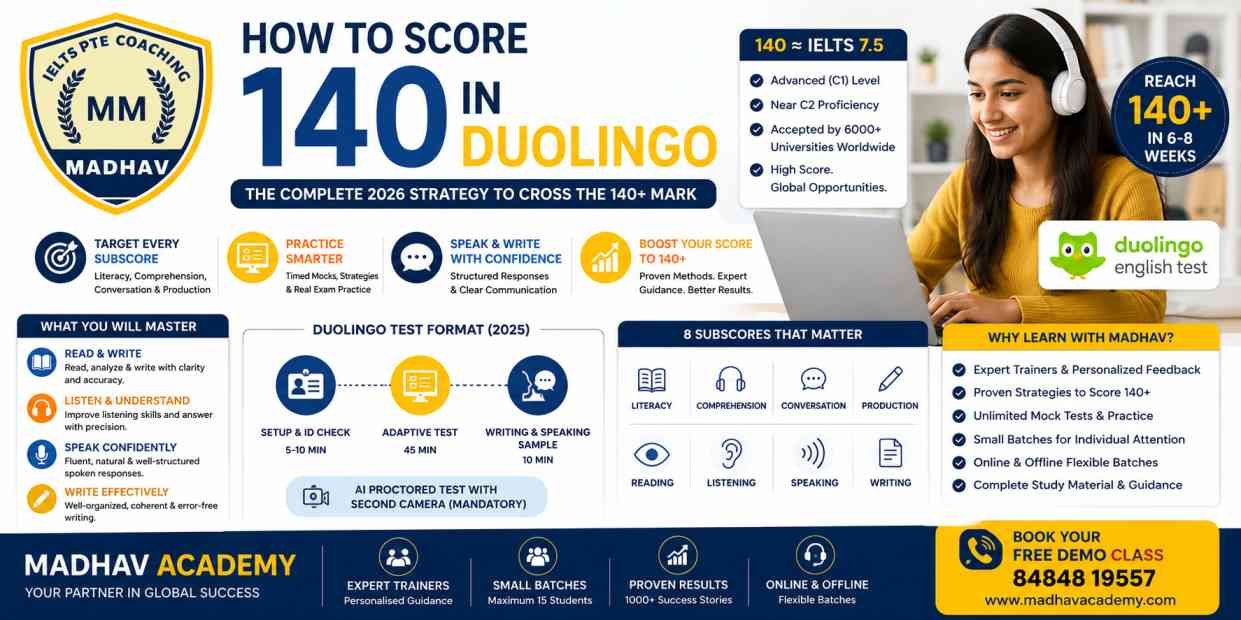
Quick Answer: Learn how to score 140 in Duolingo with a section-by-section 2026 strategy, subscore tactics, timelines & mistakes to avoid. Expert DET coaching in Pune.
take timed mock tests, structure your interactive writing clearly, and speak fluently and accurately in interactive speaking. Most upper-intermediate learners reach 140 in six to eight weeks of focused, feedback-driven practice.
Your dream university just asked for a 130+ Duolingo score. You booked the test, felt confident, and landed at 120 — again. Sound familiar? Figuring out how to score 140 in Duolingo is where most Pune aspirants hit a wall, because the DET rewards balanced, precise English, not last-minute cramming.
Here’s the good news: 140 is very achievable with the right plan. It maps to roughly IELTS 7.5 and sits in the advanced C1 band, on the doorstep of C2 — the level top universities in Canada, the UK, and Australia love to see. At IELTS With Madhav, we’ve watched working professionals and students go from a shaky 120 to a confident 140 in a matter of weeks. This guide shows you exactly how.
A 140 on the Duolingo English Test signals advanced (C1) English proficiency, right on the border of the C2 near-native band, and maps to roughly IELTS 7.5. On a scale that runs from 10 to 160 in five-point steps, 140 puts you in the top proficiency tier accepted by highly selective universities worldwide.
To put that in context, the DET is now accepted by over 6,000 institutions across more than 110 countries, including all eight Ivy League universities. Most programs ask for a score between 105 and 125; competitive degrees in engineering, computer science, business, nursing, and health sciences often want 120 or higher. A 140 comfortably clears almost every academic requirement you’ll meet.
Here’s how a 140 compares across the major tests:
| Duolingo (DET) | IELTS Band | CEFR Level |
|---|---|---|
| 160 | 8.5–9.0 | C2 |
| 145–155 | 7.5–8.0 | C1–C2 |
| 140 | ~7.5 | C1 (near C2) |
| 130–135 | 7.0 | C1 |
| 120–125 | 6.5 | B2–C1 |
| 105–115 | 6.0 | B2 |
| 90–100 | 5.0–5.5 | B1–B2 |
Based on Duolingo’s official concordance data.
One clarification that trips up many students: the DET is an admission test, not an immigration test. It’s accepted for university entry, but Canadian PR through Express Entry still needs IELTS General Training or CELPIP — IRCC does not accept Duolingo for permanent residence as of 2026.
Cracking how to score 140 in Duolingo comes down to one shift in thinking: stop studying “for the test” and start engineering each subscore. The DET reports four integrated subscores — Literacy (reading + writing), Comprehension (reading + listening), Conversation (speaking + listening), and Production (speaking + writing) — plus four individual skill scores. Your lowest subscore is your ceiling, so that’s where your prep hours should go first.
The test has three parts: a short setup and ID check, a 45-minute adaptive section that mixes all four skills, and a 10-minute writing and speaking sample. It’s roughly an hour, taken from home with a webcam and — since September 2025 — a mandatory second smartphone camera.
Practical habits that consistently lift scores toward 140:
Most upper-intermediate learners already scoring 120–125 reach 140 in about six to eight weeks of structured practice at 8–10 hours a week. Learners starting lower need longer, but a focused, feedback-driven plan almost always beats months of unguided self-study. The key variable isn’t talent — it’s whether someone is correcting your errors.
Use this roadmap to set a realistic target:
| Current DET Score | Level | Focused Prep to Hit 140 | Weekly Hours |
|---|---|---|---|
| 120–125 | Upper-intermediate | 4–6 weeks | 8–10 |
| 105–115 | Intermediate | 8–10 weeks | 10–12 |
| 90–100 | Lower-intermediate | 12–16 weeks | 12–15 |
| Below 90 | Foundation | 4–6 months | 12–15 |
This is exactly why structured coaching outperforms going it alone:
| Self-Study | Structured Coaching (IELTS With Madhav) |
|---|---|
| You guess your weak subscore | Diagnostic mock pinpoints it in week one |
| No one corrects speaking/writing errors | One-on-one feedback on every sample |
| Random YouTube tips | Personalized study plan for your target score |
| Motivation dips alone | Small-batch accountability, online or offline in Pune |
You can absolutely self-prep to 140 — but you’ll usually get there faster with a plan built around your specific gaps.
Marathi and Hindi speakers often plateau below 130 because they’re fluent but not accurate — and the DET’s AI scoring is unforgiving about grammar. Small, habitual slips in articles (a/an/the), prepositions, and subject-verb agreement quietly pull down the production and conversation subscores, even when the speaker sounds confident.
Take Rohan, an IT professional from Hinjewadi. He’d scored 122 twice and couldn’t understand why — his spoken English at work was strong. When we reviewed his recordings, the issue was obvious: he spoke quickly and naturally but dropped articles and mixed up tenses under time pressure. Two weeks of accuracy drills and structured speaking practice, and he crossed 138 on his next attempt.
Then there’s Priya, a nursing graduate from Kothrud aiming for a UK Master’s. Her writing was full of long, ambitious sentences — and errors. Once she switched to shorter, cleaner sentences, her literacy subscore jumped and her overall hit 141.
The patterns we see again and again with regional-language backgrounds:
None of these are talent problems. They’re trainable habits — which is exactly what targeted coaching fixes.
If your goal is university admission and you want fast, affordable results, the DET is an excellent choice — it costs around USD 70 (roughly ₹6,000), delivers scores in about 48 hours, and stays valid for two years. If your path runs through immigration or PR, IELTS or CELPIP is the safer bet. Many Pune students actually prepare for both, and choosing correctly upfront saves time and money.
This is where expert guidance pays off. IELTS With Madhav offers dedicated Duolingo coaching in Pune alongside IELTS, PTE, and OET preparation — with personalized study plans, unlimited mock tests with feedback, and one-on-one speaking practice that targets the exact subscore holding you back. Whether you’re in Wakad, Baner, Deccan, Viman Nagar, or across PCMC, you can join online or offline batches led by trainers with a proven record of pushing students into the 130–150 range.
Learning how to score 140 in Duolingo isn’t about studying harder — it’s about studying the right things with someone who can see the mistakes you can’t.
You now know exactly how to score 140 on Duolingo — the strategy, the timeline, and the mistakes to dodge. The difference between 120 and 140 is rarely effort; it’s precision and expert feedback.
Book your free demo with Madhav today and get a personalized Duolingo study plan built around your target score. Join hundreds of Pune students who turned “almost there” into an offer letter.
📞 Call or WhatsApp: +91 8855829557
🌐 Website: ieltswithmadhav.com

Yes, 140 is an exceptional Duolingo score. It falls within the advanced C1 band, borders C2, and corresponds roughly with IELTS 7.5, thus qualifying you to enter selective universities across Canada, the UK, Australia, and the US with competitive engineering, business, or health science programs.
Focusing first on improving the weakest subscore is key for succeeding with upper intermediate learners already at 120-125; take full-length timed mock tests weekly for expert feedback, and focus on strengthening weak areas with targeted structured practice sessions. With focused structured practice sessions lasting four to six weeks, upper intermediate learners could reach 140.
The Duolingo English Test gives you up to three attempts within any 30-day period, with scores remaining valid for two years and offering universities free reports—making this a low-risk, flexible option that's perfect.
No, the Duolingo English Test (DET) is not accepted for Canadian permanent residency purposes by Immigration, Refugees, and Citizenship Canada (IRCC). Instead, IELTS General Training, CELPIP-General, and PTE Core exams are accepted for Express Entry and PNP applications; university admission via DET support study permit applications through acceptance letters issued from universities.
Your DET overall score (10-165) reflects total proficiency, while its four subscores—literacy, comprehension, conversation, and production—provide further detail on skills. Universities look at both scores equally; therefore, ensuring your profile includes no weak subscores matters just as much as its headline number.
Get expert guidance, personalized study plans, and real exam strategies
to crack IELTS, PTE, TOEFL & more with confidence
Top learning experiences that create more talent in the world.